
Plug-in solar is about to become a reality on UK high streets. Energy Secretary Ed Miliband confirmed in March 2026 that the government is legalising small-scale plug-and-play solar panels for domestic use for the first time, with kits expected to appear in supermarkets and DIY retailers by summer 2026.
It is an exciting development. For millions of households in rented accommodation, flats or properties where a full rooftop installation simply is not practical, plug-in solar removes barriers that have existed for years. At roughly £190 a year in estimated energy savings for a basic two-panel setup, the economics are compelling — particularly as energy bills continue to bite.
But here at Hobbs Electrical Group, we want to be straight with you, because we think the conversation happening in the trade needs to catch up with the one happening at the kitchen table.
What Is Plug-In Solar?
A plug-in solar system — sometimes called balcony solar or plug-and-play solar — typically consists of one or two compact photovoltaic panels paired with a micro-inverter. The panels capture sunlight, the inverter converts the DC power to AC, and the system feeds electricity directly into your home, reducing what you draw from the grid in real time.
The panels can be mounted on balcony railings, fixed to a wall, placed in a garden, or set up on a patio. No scaffolding, no roof work, no major structural changes.
The UK is following Germany's lead, where this technology has been legal and widely adopted for several years, with over one million registered installations and a real-world installed base estimated to be considerably higher.
Where Does UK Law Stand Right Now?
The regulatory picture is moving quickly:
16 March 2026: Energy Secretary Ed Miliband confirmed the government will legalise plug-in solar for UK homes.
15 April 2026: BS 7671 Amendment 4 was published and came into force, updating the UK wiring regulations to formally acknowledge small-scale plug-in generation systems and introduce new requirements around load balancing and circuit protection.
Expected July 2026: The BSI product standard for plug-in solar kits is due to be published. This is the standard that will allow manufacturers to certify products for UK DIY self-connection without an electrician.
15 October 2026: The transition period for BS 7671 Amendment 4 ends, after which compliance is mandatory.
The key detail right now: until the BSI product standard is published, the compliant route to connecting a system is through a qualified electrician. Once the standard is in place, a certified kit under 800W can legally be plugged into a standard 13A socket — no electrician required.
The 800W output limit is deliberate. It sits well within the safe operating envelope of a standard domestic ring main and matches the approach already proven in Germany.
Is Plug-In Solar Dangerous?
The electrical industry has raised concerns, and some of those concerns are legitimate. But it is worth unpacking what the actual risks are, rather than treating plug-in solar as inherently dangerous.
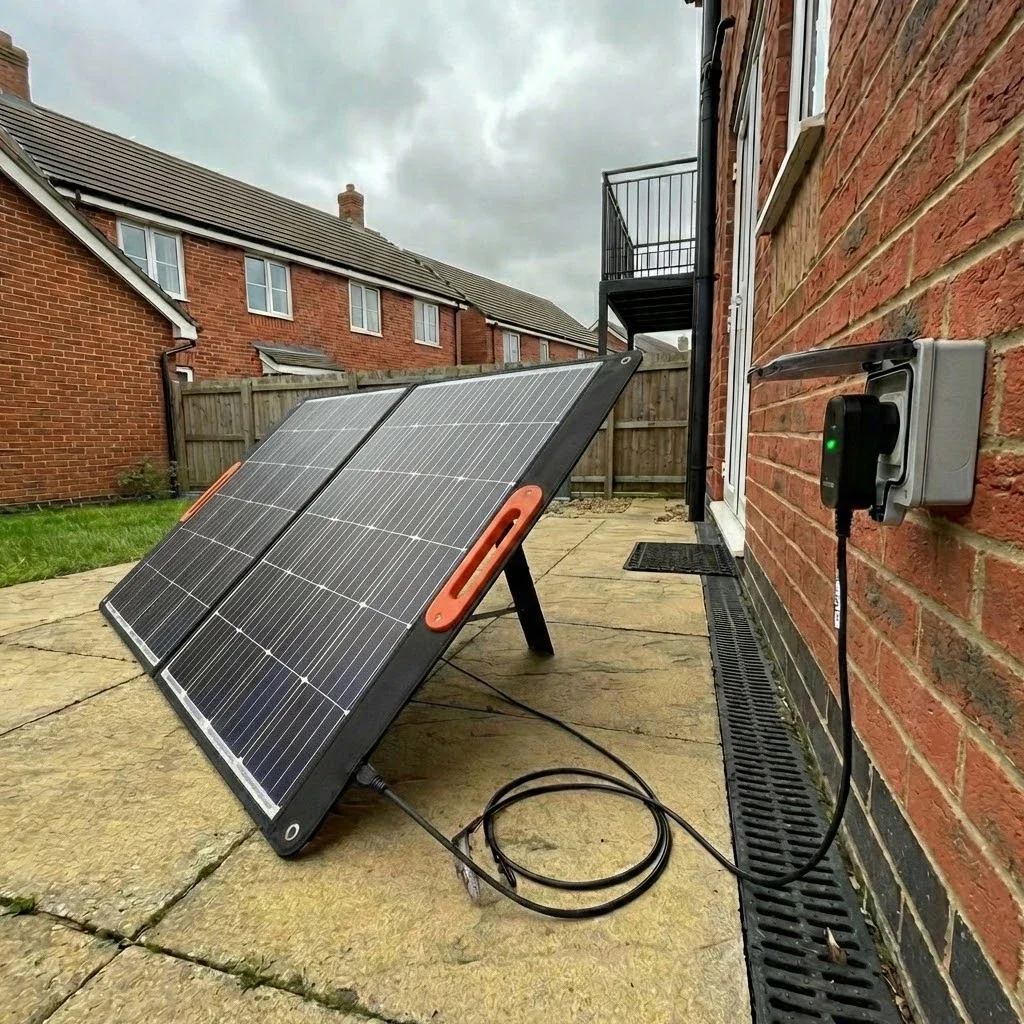
Plug-in solar panels installed in a UK garden — Hobbs Electrical Group
Anti-Islanding Protection
The requirement for an inverter to shut down the moment the grid supply is lost is not new technology and is not missing from plug-in solar units. It is the same protection that has been mandatory on every permanently installed solar system in this country for years. Independent testing has demonstrated that compliant micro-inverters shut down rapidly and reliably when mains supply is lost, even in scenarios where multiple units are daisy-chained or appliances are running simultaneously.
Bidirectional RCDs
This is a real consideration. The wiring regulations have flagged that some electronic RCDs and RCBOs can be affected by reverse power flow — not necessarily by failing to trip, but by potential damage to internal electronics that might only become apparent later. BS 7671 Amendment 4 directly addresses this as part of the updated framework.
The Real Risks Are Simpler
Running an outdoor system through an old socket with no RCD protection. Using worn or underrated extension leads. Stacking multiple systems beyond the single-unit limit. Poor panel mounting leading to wind loading failures — something that has already caused costly accidental damage in early UK installations.
None of those risks are unique to solar. They are the risks that exist whenever electrical equipment meets old, untested or modified domestic wiring — which leads us to the most important point we want to make.
Our Advice: Get an EICR First

Balcony plug-in solar panel installation — Hobbs Electrical Group
Hobbs Electrical Group does not currently offer plug-in solar installation. This technology is specifically designed to be user-fitted once the BSI product standard is in place.
But here is what we do strongly recommend, and it matters more than almost any other single step you can take before connecting any generation device to your home: get an Electrical Installation Condition Report (EICR) carried out on your property first.
An EICR is a formal inspection of your fixed electrical installation by a qualified electrician. It assesses the condition of your consumer unit, your circuits, earthing, bonding, RCD protection and overall safety. It identifies deterioration, outdated components, lack of protection, or wiring that no longer meets modern expectations.
Why does this matter for plug-in solar? Because the 800W output limit is calibrated to the safe operating envelope of a standard, reasonably modern domestic installation. If your consumer unit is old, your wiring has not been inspected for decades, your socket circuits lack RCD protection or your earthing is inadequate, the risk profile changes — regardless of how good the plug-in solar product itself is.
The IET has explicitly recommended an EICR before connecting any generation device. The independent engineering community has echoed this. We agree completely.
A significant number of UK electrical installations have not been inspected or tested for many years. In older properties across Hertfordshire, Bedfordshire, Buckinghamshire and London — the areas we work in — this is not unusual.
An EICR before installation gives you three things:
Confirmation that your installation is safe to support plug-in generation
Clarity on any limitations — for example, if your socket circuits are unprotected, we can advise on what that means in practice
Peace of mind that the savings you generate from your solar panels are not being offset by a risk you did not know was there
What Hobbs Electrical Group Can Do for You
We are a NAPIT-registered electrical contracting company, co-directed by a Master Electrician and a C&G 2391-52 inspection and testing qualified electrician. EICR is core work for us, and we carry it out to the current 18th Edition BS 7671 standard, including BS 7671 Amendment 4.
If you are planning to install plug-in solar — or if you are simply not sure when your electrical installation was last inspected — we can carry out a full EICR, talk you through the findings clearly, and give you a straight assessment of whether your installation is suitable.
We cover Hemel Hempstead, Hertfordshire, Bedfordshire, Buckinghamshire and London.
We are not here to talk you out of plug-in solar. We think it is a good technology and we welcome the regulatory progress. We just want to make sure that when you plug yours in, it is going into an installation that is ready for it.
In Summary
Plug-in solar is being legalised in the UK, with the BS 7671 regulatory framework now updated and the BSI product standard expected summer 2026
Systems will be limited to 800W — enough to make a meaningful contribution to household energy bills
The core safety technology (anti-islanding protection) is proven and mandatory on compliant equipment
The real risks are not in the technology itself, but in what it gets plugged into
An EICR before installation is the single most effective step you can take to protect yourself and your home
Get in touch with Hobbs Electrical Group to book your EICR and get straightforward advice before you install.